Thinking About Salt-Free Water Softener in Saint Marks Florida?
Each piece of hardware on the market answers a particular complaint, and none answers all of them; read on for how the pieces fit together.
Phone Ackuritlabs And Aqua Systems at 850-616-2634 to ask which questions come before any equipment.
The Order of Operations: Naming the Target
Taste and appearance narrow the field, though only a lab report settles it, and the figure is what a provider uses to size and pick the unit. A first conversation commonly ends with advice on what to sample before the next step, and a short delay beats replacing the wrong unit.
The Salt-Based Softener: How the Resin Works
The beads in a softener hold hardness minerals until they are rinsed clean; a control valve decides when to regenerate by clock or by usage. Scale buildup on heaters, kettles and shower heads slows down where hardness has been removed; the lab result still decides what else belongs in the plan.
Scale Control Without Salt: an Honest Comparison
Conditioners leave the hardness figure unchanged and change the shape of the crystals that form, which suits some households and some local rules. Expect scale to be reduced rather than eliminated, and expect no change in how soap lathers, and a good provider explains that before the purchase.
Adsorption Media: Why Cartridges Run Out
Carbon holds onto certain compounds as supply passes through, which cuts chlorine taste and some odors; each type of carbon targets specific compounds, so the media is picked to suit the finding. A saturated filter can release what it captured, which is why change schedules matter, and the maker's change interval is a guide, not a promise.
Canisters on the Line: Sizes, Ratings and Swaps
Grit and flakes get stopped by a pleated or wound element sitting in a clear or opaque canister; the rating, given in microns, states how small a particle the element is built to catch. Pressure falls as an element loads up, which is the practical signal to swap it; replacements are sold by size, so note the model.
Drinking Supply Upgrades: Pressure, Membrane and Reject Stream
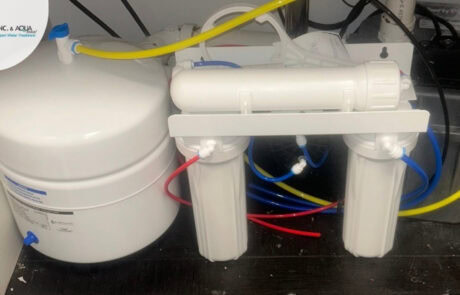
Dissolved solids stay on one side of the membrane and get flushed away; compact units fit under a sink and serve a single tap. Reverse osmosis units reduce many dissolved substances, though performance varies by model and by supply; ask for the maintenance schedule in writing.
Treating Iron, Sulfur and Microbes: What the Installer Sets Up
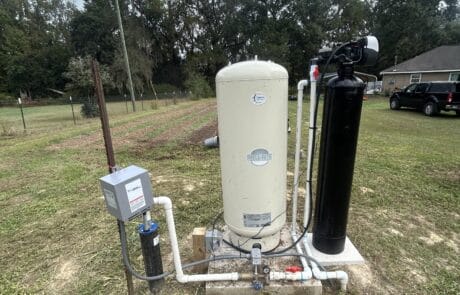
The setup pairs a feed pump with a retention tank so the chlorine has time to work; the tank is sized to the flow of the well. Residual chlorine has to be removed afterward, and a carbon filter normally takes that job, and chemical equipment is installed and set up with care.
Whole-House or Single-Tap – One Tap, One Sink, One Appliance
A unit at the main line treats every tap, the shower, the washer and the water heater; the flow at the entry is worth measuring before ordering. Many households combine both: a main-line device for scale and a sink model for taste, and the two approaches work well together.
Sizing – People, Fixtures and Usage
Treating the household's peak demand, not its average, keeps pressure from dropping; high readings use up capacity faster. Equipment that is too small works harder and wears out sooner; a reasoned answer is a good sign.
What the Job Requires: Bypass Valves, Drains and Outlets
Shutoffs on both sides of a unit make servicing simple; the walk-through before work matters. Codes affect drain connections, backflow protection and the placement of equipment; leave room to open the tank lid and swap a cartridge.
Private Source or Public Main: Chlorine Added or Not
Raw well supply brings the chemistry of the ground straight to the plumbing, and the right system differs accordingly. Equipment picked from a neighbor's experience may not suit a different source; photos of the existing equipment help.
After an Outage: What to Check Afterward
Many controllers keep their program in memory for a short while, and then need to be set again, since a stuck valve is easier to catch early. A flooded system should be shut off and checked before use, since damage is not always visible; keep manuals and settings notes together.
Where Everything Goes – Placement Decisions That Last
Pumps and metering equipment hum when they work, so placement matters for bedrooms and offices, and a level pad keeps tanks from shifting. Equipment is easiest to live with when the controls and the drain sit where a person can reach them, and the installer can suggest a layout.
Upgrading What Is Already There – Keep, Repair or Replace
A house may come with equipment that nobody remembers installing, so a look at the labels is the first step, and the readings guide whether to repair, keep or replace. New components usually have to fit the pipe sizes, the pressure and the drain already in place; photographs of the current setup speed up the first conversation.
Commercial Systems: Boilers, Ice Machines and Kitchens
Boilers, cooling equipment and ice makers can be sensitive to scale, which shapes the design, and a drawing of the proposed layout is a reasonable request. Commercial owners usually want service records, so the system should make them easy to keep, and it supports any later troubleshooting.
Upkeep: Signs a Unit Needs Attention
Soft supply depends on a brine tank that is kept stocked; a label on each housing with the install date helps. Warning signs include a return of the old taste, scale reappearing and a drop in pressure; do not wait for a complete failure.
Closing the Loop: Before and After Side by Side
The most reliable verification is a fresh panel run on the same items as before, which matters for cartridges and media that wear. Some substances respond well and others hardly at all, which the new figures reveal; the file is useful for a future sale.
Limits to Keep in Mind – Matching Promises to Physics
A softener will not make a supply taste different, and a carbon filter will not soften it; ask for the specific substances a product addresses. A provider unwilling to discuss limits is one to think twice about; nothing here replaces advice for your property.
Before You Sign: Scope, Parts and Follow-Up
- Which lab results is the proposal based on, and which items does it address; a specific answer is what you want.
- Which local rules apply to this installation, and who handles them, and how can questions be raised afterward.
- Where should the paperwork for the system be stored, and what does it say about future servicing.
Planning a System: Questions Are the Starting Point
Speak with Ackuritlabs And Aqua Systems at 850-616-2634 and ask what to collect before any equipment is chosen.
In Plain Terms – the Sequence That Works
Matching a device to a lab result, sizing it to the building and keeping up with upkeep is the whole recipe, because each property in Saint Marks Florida has its own story, whatever any page says about Salt-Free Water Softener. You can speak with Ackuritlabs And Aqua Systems at 850-616-2634 about your plumbing and your goals; the details you share shape the advice.
Verified

Verified
Verified
Verified
Verified