Thinking About Water Treatment in Hilliard Florida?
Equipment gets chosen to fix a measured problem, and the fix is only as good as the diagnosis behind it; the sections below describe what each option does and where it stops.
Call Ackuritlabs And Aqua Systems at 850-616-2634 to ask how an installation is planned.
The Order of Operations – Results Decide the Hardware
Taste and appearance narrow the field, though only a lab report settles it; a sample sent to a laboratory turns a guess into a figure. Anyone without a recent report can usually be pointed to a suitable panel first; skipping ahead is where most mismatches begin.
Resin Tanks: Regeneration in Plain Terms
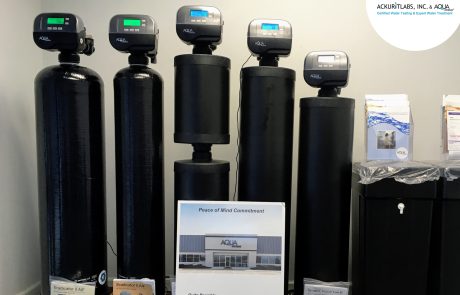
The beads in a softener hold hardness minerals until they are rinsed clean; when the beads fill up, a brine rinse flushes the captured minerals to a drain. Laundry and dishes tend to come out cleaner where the minerals have been removed, though a softener does little for iron staining beyond a modest level.
Conditioning Instead of Softening – Setting Expectations
A salt-free unit does not remove calcium or magnesium; it alters how those minerals behave; people choose these devices to avoid salt, brine discharge and a drain connection. A conditioner will not give the slick feel that a softened supply has in the shower; being clear on this point prevents disputes later.
Carbon Filtration – Granular Beds and Blocks
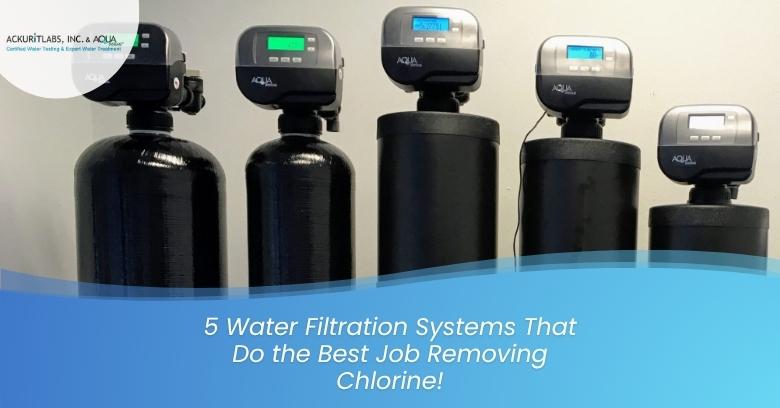
Porous carbon traps many organic molecules and chlorine on its surfaces as flow moves across them; a catalytic grade is often used where chloramine is the disinfectant. Contact time and flow rate affect results, and a unit pushed too hard performs worse; a taste that creeps back is the usual reminder.
The Filter Under the Cap – Catching Grit Before It Travels On
The simplest way to protect a pump, a softener or a fixture is usually a sediment screen ahead of it, and the sequence is part of the design. A carbon cartridge installed in the same housing style handles taste while the sediment unit handles grit, and a pressure gauge on each side of the housing makes that visible.
Membrane Systems – Dissolved Solids Reduced
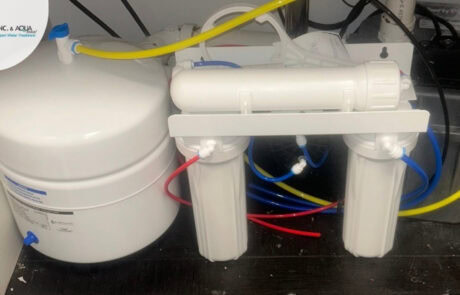
Pressure pushes the supply against a semipermeable membrane, and most dissolved material is held back, and a small storage tank holds finished supply for the dedicated faucet. Reverse osmosis units reduce many dissolved substances, though performance varies by model and by supply; ask for the maintenance schedule in writing.
Chlorination: What the Installer Sets Up
A metering pump feeds sodium hypochlorite into the flow, and a tank gives it time to react, and it also acts on bacteria in the supply. Where the supply is meant for drinking, the leftover chlorine is filtered off; chemicals are stored and handled according to the label.
Where the Equipment Sits: Choosing the Footprint
Whole-house layouts put one set of equipment ahead of every fixture; the flow at the entry is worth measuring before ordering. Where only one fixture matters, a compact installation avoids treating the whole house, and the two approaches work well together.
Matching the Unit to the House: What Undersizing Looks Like
Treating the household's peak demand, not its average, keeps pressure from dropping; high readings use up capacity faster. A well-matched system suits the building rather than the biggest model on offer; ask to see the numbers behind the recommendation.
What the Job Requires: Tying Into Existing Lines
Shutoffs on both sides of a unit make servicing simple; the installer plans the route up front. Whoever does the installation should be able to say what the local rules ask for, and access for servicing should be planned from the start.
Wells Versus City Lines: Planning Around the Source
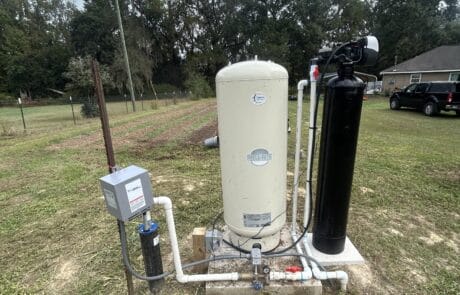
City lines usually deliver a steady, disinfected supply, so the complaints tend to be taste and scale; sediment and iron tend to be the early concerns. The provider needs to know which source feeds the house before suggesting anything; mention the source on the first call.
Storms and Power Interruptions – Protecting Gear From Surge and Silt
Pumps, injectors and controllers all depend on electricity, and an outage pauses every one of them, since a stuck valve is easier to catch early. If floodwater covered the wellhead, the supply itself needs a fresh lab sample; keep manuals and settings notes together.
Living With the Equipment – Reaching the Controls
A recharge brings gurgling and flowing noises for a spell, usually at a scheduled hour, and a level pad keeps tanks from shifting. Equipment is easiest to live with when the controls and the drain sit where a person can reach them; a tank that cannot get through a doorway is a common surprise.
An Older System in the Garage – Reading Old Labels
A house may come with equipment that nobody remembers installing, so a look at the labels is the first step; the model number on the label usually leads to a manual and a parts list. Adding a stage to an existing setup requires attention to order, flow rate and pressure drop; nothing is replaced without a reason.
Larger Buildings and Heavier Demand: Written Specifications
Restaurants, offices and apartment buildings draw far more than a house, and the gear is scaled to match; the survey of the site comes first. Training the people on site about shutoffs and alarms prevents small problems from growing; ask what monitoring the equipment offers.
Service Schedule: What Gets Neglected
Every type of equipment has a consumable: salt for softeners, cartridges for filters, membranes for osmosis units; a label on each housing with the install date helps. If stains come back, or the taste creeps back, something in the chain has used up its capacity; do not wait for a complete failure.
Verifying What Changed: Tracking Performance
Measurements taken after setup show the change in black and white; a retest a few months in shows whether the system is holding. If a reading is still high, the report guides the next adjustment; the file is useful for a future sale.
Honest Limits: Questions for Any Seller
Equipment performs within limits set by its design, the supply and the upkeep; ask for the specific substances a product addresses. Anyone selling treatment equipment should be able to explain what it reduces and what it leaves alone; nothing here replaces advice for your property.
Questions for a Provider – Everything in Writing
- Is the recommended size tied to the lab figures and the household's flow; ask for the reasoning in writing.
- How is the unit set up at the start, and what will you be shown before the crew leaves, and how can questions be raised afterward.
- Which items are checked on a routine visit, and which need special tools; each of these is worth asking.
Planning a System – Share Your Lab Report
Call Ackuritlabs And Aqua Systems at 850-616-2634 to find out how a system would be planned and sized.
Pulling the Threads – the Sequence That Works
A dependable setup follows a sequence: measure the supply, pick equipment to suit, install it carefully and test again, and for Water Treatment in Hilliard Florida the first step is a conversation about the supply and the symptoms. You can speak with Ackuritlabs And Aqua Systems at 850-616-2634 about your plumbing and your goals, and say what you would like to change.
Verified

Verified
Verified
Verified
Verified