Looking for Chlorine Injector Installation in Newport Florida?
Good installations start from a lab result and work toward a device that suits it; read on for how the pieces fit together.
Contact Ackuritlabs And Aqua Systems at 850-616-2634 and say whether the supply is a well or a city line.
The Step Ahead of the Purchase: Naming the Target
Taste and appearance narrow the field, though only a lab report settles it; having a report on hand speeds everything up. A first conversation commonly ends with advice on what to sample before the next step; skipping ahead is where most mismatches begin.
Taking Out Hardness – Swapping Minerals for Sodium or Potassium
The core of a standard softener is a resin bed that exchanges hardness minerals for a softer ion; the unit needs a drain line and a power outlet. Scale buildup on heaters, kettles and shower heads slows down where hardness has been removed; the lab result still decides what else belongs in the plan.
Salt-Free Conditioners: an Honest Comparison
Nothing is exchanged, so the lab number for hardness reads the same before and after; people choose these devices to avoid salt, brine discharge and a drain connection. A conditioner will not give the slick feel that a softened supply has in the shower; ask what the device will not do.
Taste and Odor Control – Contact Time and Capacity
Carbon holds onto certain compounds as supply passes through, which cuts chlorine taste and some odors, and ordinary carbon handles free chlorine more easily than chloramine. Contact time and flow rate affect results, and a unit pushed too hard performs worse, and the maker's change interval is a guide, not a promise.
Canisters on the Line: Reading the Micron Number
Particle filters are the first stage in many systems, catching whatever would clog the rest, and the sequence is part of the design. Carbon cartridges, including carbon block types, often sit downstream of the sediment stage; write the swap date on the canister.
Reverse Osmosis: Fair Expectations
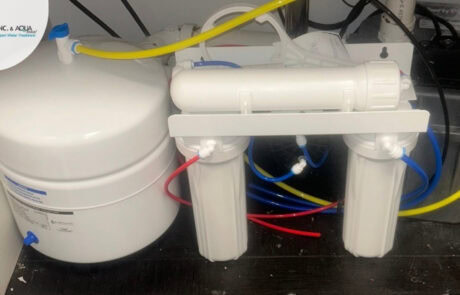
A membrane passes the liquid and rejects a large share of dissolved salts and other solids; the rejected stream runs to a drain, so a connection to the sink drain is part of the installation. Pre-filters protect the membrane, and replacing them on time protects the system; a leak sensor is a sensible add-on.
Oxidation Systems: Why Dose Control Matters
The setup pairs a feed pump with a retention tank so the chlorine has time to work; the chlorine oxidizes iron and sulfide into forms that can be filtered out. Residual chlorine has to be removed afterward, and a carbon filter normally takes that job, and the setup should be checked after the first weeks.
Treating Everything or Just the Faucet – Matching Scope to Need
Everything inside the building sees treated flow when equipment sits at the entry; the flow at the entry is worth measuring before ordering. A point-of-use unit serves a single faucet, usually the kitchen, and suits drinking and cooking, and the two approaches work well together.
Peak Demand Math – People, Fixtures and Usage
Ratings printed on the label describe the equipment, and the installer matches them to the building, along with the hardness or iron level on the lab report. An undersized system forces flow past the media too fast, which weakens the result; ask to see the numbers behind the recommendation.
Space and Connections: the Checklist Behind a Clean Install
Most systems need a bypass valve so the plumbing can keep flowing during service; the installer plans the route up front. Local plumbing and electrical rules may apply, and the installer is the one to know them, and access for servicing should be planned from the start.
Two Starting Points: Chlorine Added or Not
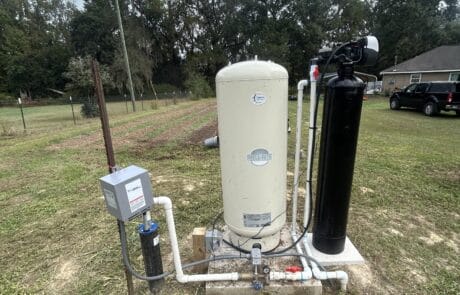
Private wells deliver untreated groundwater, which can carry iron, sulfur, hardness and microbes; wells also bring a pump and a pressure tank into the plan. Equipment picked from a neighbor's experience may not suit a different source; photos of the existing equipment help.
Weather and the Equipment Room: Planning Before the Season
Softeners and filters with electronic controllers can lose their settings in a long outage unless a backup battery holds them, and the manual shows how to reset the controller. A flooded system should be shut off and checked before use, since damage is not always visible; write down the shutoff locations.
Day-to-Day Presence – Placement Decisions That Last
Most residential units are quiet, and the sounds they make are short bursts when a valve cycles or a recharge runs; a garage, a utility closet or a pump house is the usual home. Some owners build a small enclosure, though it must not block air or access, and the installer can suggest a layout.
Working With Existing Equipment: Test Before Deciding
A house may come with equipment that nobody remembers installing, so a look at the labels is the first step, and the provider can often read the date code. Adding a stage to an existing setup requires attention to order, flow rate and pressure drop, and old manuals are worth saving.
Equipment for Operations: Written Specifications
Larger buildings may need several tanks and manifolds, not one household unit, and a drawing of the proposed layout is a reasonable request. Commercial owners usually want service records, so the system should make them easy to keep; ask what monitoring the equipment offers.
Routine Care – Setting Reminders
Soft supply depends on a brine tank that is kept stocked; the manual lists intervals, though a heavy load shortens them. If stains come back, or the taste creeps back, something in the chain has used up its capacity; do not wait for a complete failure.
Closing the Loop: When to Retest
A sample collected after the system is running shows whether the problem was solved; a retest a few months in shows whether the system is holding. Treatment can reduce certain items without eliminating them, and the report shows by how much; the file is useful for a future sale.
Limits to Keep in Mind – Read the Fine Print
Equipment performs within limits set by its design, the supply and the upkeep; ask for the specific substances a product addresses. A fair provider will tell you when equipment is not the fix, or not the whole fix, and a plain no is sometimes the most useful answer.
Questions for a Provider – Everything in Writing
- Does the plan name the substances it targets, rather than speaking in general terms; ask for the reasoning in writing.
- Where will the drain, the power and the bypass go, and what will be cut or moved; ask for a copy of the manuals too.
- Where should the paperwork for the system be stored; write the answers down.
A Call Before a Purchase: Describe the Problem First
Call Ackuritlabs And Aqua Systems at 850-616-2634 to find out how a system would be planned and sized.
What to Remember – Upkeep Keeps It Working
Good outcomes come from habits worth repeating: testing first, buying second and checking afterward, and everything above about Chlorine Injector Installation in Newport Florida is general background, not a verdict. Questions are welcome at 850-616-2634, where Ackuritlabs And Aqua Systems can lay out the options, and share what the lab report shows.
Verified

Verified
Verified
Verified
Verified